
Syzygies
-
Posts
1,751 -
Joined
-
Last visited
-
Days Won
55
Content Type
Profiles
Forums
Events
Everything posted by Syzygies
-
I have a convection oven. The reviews make me wonder about rack setups that optimize for this "air frying" effect in a convection oven: Suspend one's rack well above the drip tray, and dead center in the convection breeze? Most of us haven't adapted our cooking habits to convection; this "portable convection oven" reveals what is possible.
-
As a 23" owner, I can see the 32" killer app for me would be as a bread oven. I can fit two large loaves in my 23", but I've never tried to squeeze in three loaves. I can easily find homes for three loaves. If I had a 32", I'd order a large rectangular Fibrament pizza stone, and bake away.
-
Wow. I've fed up to a hundred people out of my 23, pork butt, and yet it never feels too big, cooking for two. Brisket doesn't go as far, spareribs even less so. If I had the 32, I'd cook spareribs more often for larger groups. And whole animals would be more often an option, like baby goat, lamb, or suckling pig. At least when Laurie's out of town. Anyone thinking the 23 is too big because they're often cooking for two should just go for it, not a concern. And anyone stunned into deer-in-the-headlights inaction by this choice, again just get the 23, either it will hardly ever be too small or else you already know you want the 32. 32, wow, I have to digest this. Franklin Barbecue did weld a smoker from a 500 gallon propane tank before deciding not to waste their time like that again, they stick to 1,000 gallon tanks now. Same thing? When I think about it, it's not the money or the space, it's juggling the grates, which will weigh more. But then I custom order various 1/2" thick baking steels, they're like dumbbells and I don't mind.
-
The specs say 3/8" / 9mm. It is puzzling that a metric wrench isn't a better fit, but 10mm > 3/8", and 9mm doesn't fit.
-
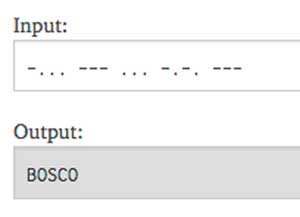
A World War II code breaker would have noticed that the second and fifth set match, as do the second and fifth letters in BOSCO, in this way cracking even a much longer message.
-
I'm thinking, here's how Bosco could really send a message:

-
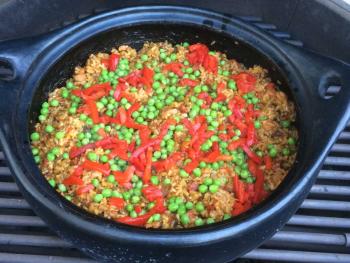
Another Spanish rice. Love this pot! Once it settles down it is amazingly nonstick, doing all steps in the pot.
-
Well, an idea popularized by Franklin Barbecue. I share a strong prejudice against foiling (I did try it) but this is an empirical question. I make my living teaching logical thought (or mathematics, somewhat the same) and any idea that doesn't check out in practice is just BS. It sure looks like Poochie nailed it, I have to try this myself.
-
Wow, what oven do you own? I've never seen a residential indoor oven as stable as my KK. (Nice review!)
-
Huh. Laurie has fairly enlightened opinions on most matters, but she does like traditional sex roles for tasks around the house. "Man cook with fire!"
-
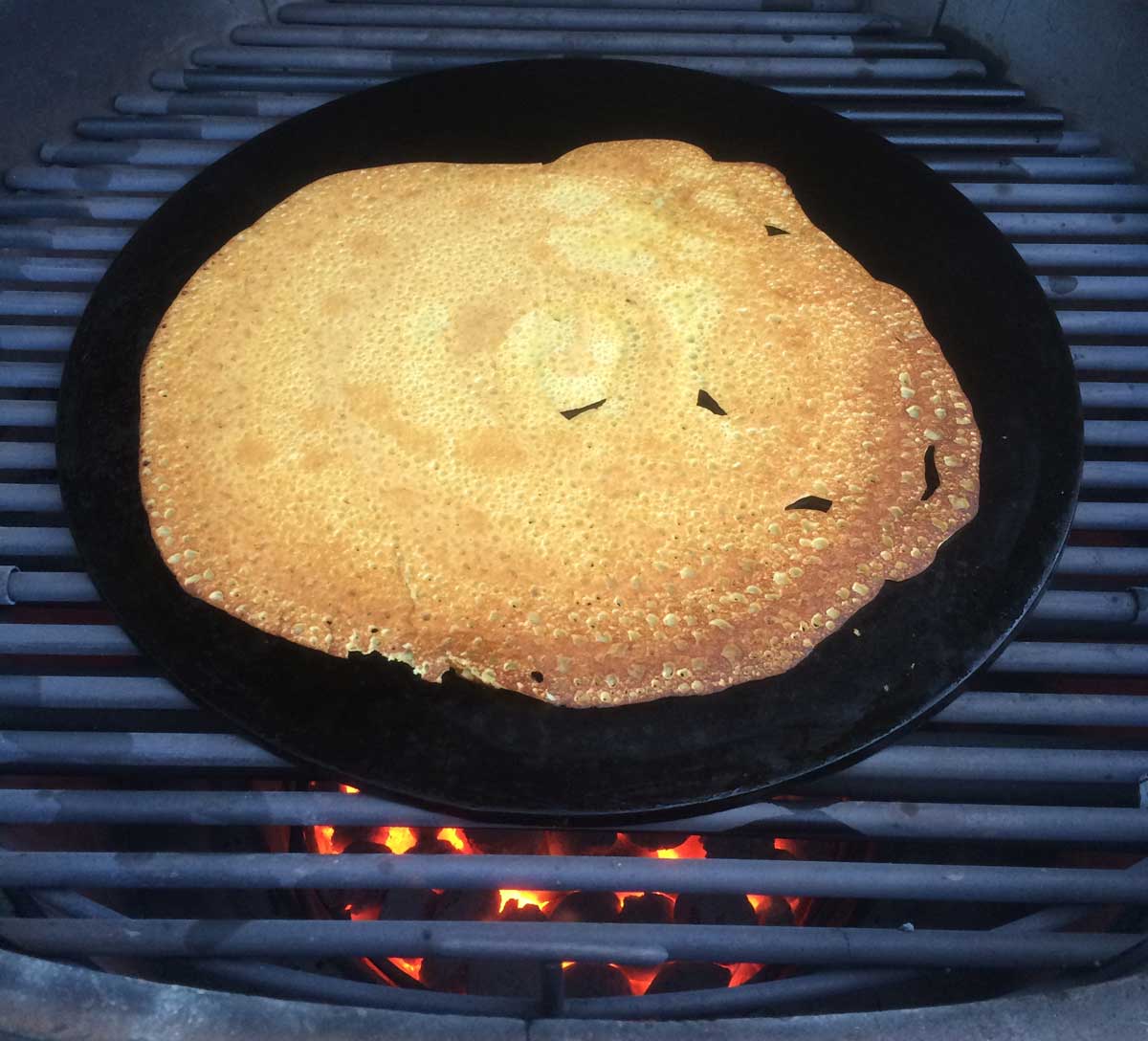
Burgers, and socca.
-
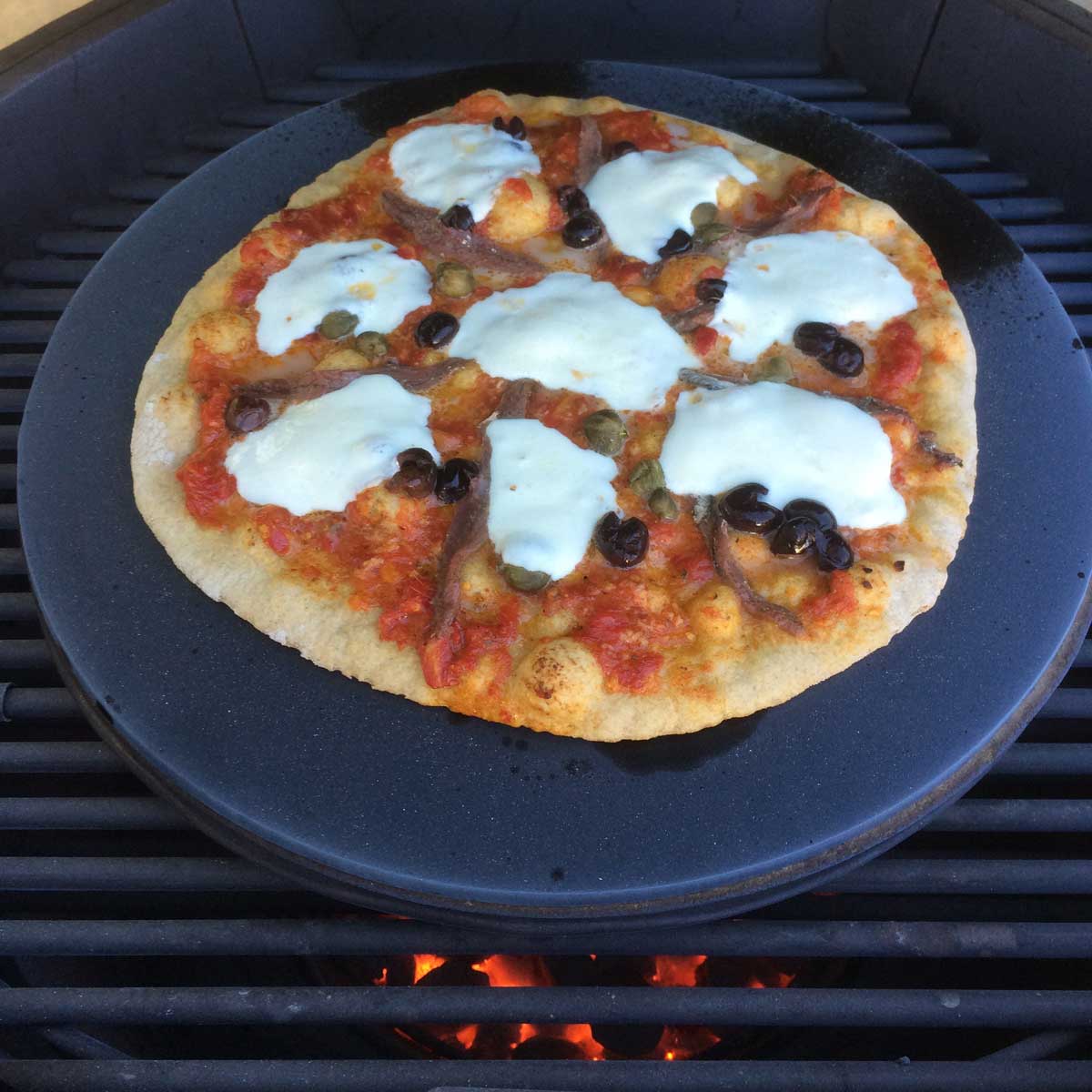
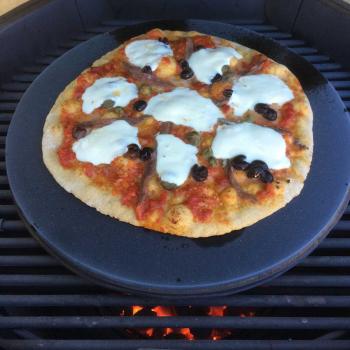
A pizza in mid-cook on a 15" round baking steel. I'm never going back. Custom order a thicker version if you're willing to lift and pay for one. In the KK, mine is on a stack with my old pizza stone and a heat deflector. I can go hotter without burning, using a steel. Not sure why, purely an empirical observation. Whole grain from freshly ground flour using a Wolfgang Mock grain mill; this won't look like a white flour pizza, no matter how we bake it. We roll to 1/8" thickness using a stepped J.K. Adams Lovely Maple Wood Rolling Pin. One can also buy bands or strips to get a uniform thickness. No crust, not needed with spare toppings.
-
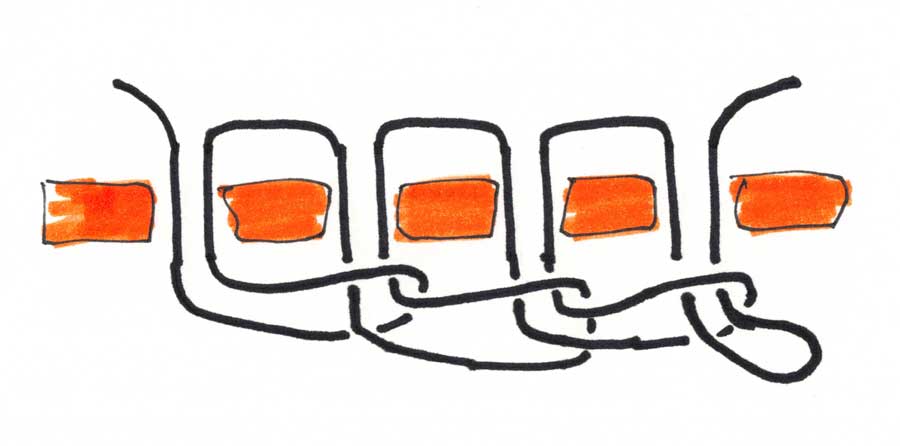
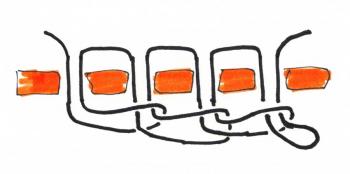
Perhaps the original bags of this form involved coarse, high quality string, so the tail on the right could be easily untangled. With the bags I have on hand, it is a fool's errand to use one's fingers to get the string started, if one has the choice of cutting off the tail to free the string one pulls. I couldn't tell from your post whether the string in fact pulls from either direction, and you were using your knife because one can't untangle the left tail by hand. Or if you simply obliterate the bag with your knife. Rather than ask, this was an easy experiment: I went to my garage, and opened another bag of charcoal. The string only pulls from the right, on the single threaded side. And by far the easiest way to get the string started is with your pocket knife. That is way less work than obliterating the bag with your knife. For everyone else reading this thread, whose garage is filling with opened bags of charcoal: One doesn't have to open the bags all the way, to try these experiments! Laurie actually understands the knots involved in sewing, and knew without experimenting that a chain stitch only pulls one way. One can see from my drawing why this is. The idea that one pulls from the right is a convention. To make this point, I almost went to the garage to open another bag, upside down. Laurie talked me out of it.
-
So I had to go try this. I have twenty bags of Lazzari charcoal to practice on. Trying to tease the start took me much longer than I ever spend with scissors, to no avail. Instead, follow the directions (right end of single-stitched side) up to finding the dangling string. Undo the first little loose knot just wasn't happening for me. However, snip off the string flush with the bag, then pull the string on your side works like a charm.
-
Best vacuum packer? (FoodSaver alternatives?)
Syzygies replied to Syzygies's topic in Relevant Product Reviews
The VacMaster VP120 appears to be the successor to the VP115, which I've had for a year now. I'm thrilled with it. I use it primarily for food storage (ideal preservation in a chest freezer), secondarily for sous vide. Though these easily run together: running a circulator without heat is the fastest way to defrost food from a chest freezer. Friends would rather make the trip to use this machine (e.g. to repack a 3 kilo tin of Cantabrian anchovies) than use a clamp machine at home. The difference is extreme. One can buy both 3 mil and 4 mil chamber bags. Unless one is running a restaurant on the verge of bankruptcy, don't bother with anything besides 4 mil bags, food safe for sous vide. One still needs bone guards for obvious culprits, but less often. The wrong shape salt crystal on Catalan cod tripe can puncture a 3 mil bag, one never sees that coming. With a mix of bags, one needs to keep adjusting the sealing times; better to stock one bag thickness. An oil pump can create a greater vacuum, and fancier controls can stop automatically at set vacuum levels. I get by fine watching the analog gauge. I can see why a restaurant would want a higher end machine. Getting water into an air pump requires a factory visit. Getting water into an oil pump is a repair one can do oneself at home. I nevertheless assess this risk as small. I balked on the oil pump models because of their size, they are close in price. If VacMaster came out with an oil pump machine in the VP120 form factor, I'd be really tempted. -
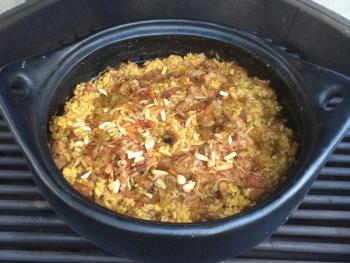
So we made a lamb biryani from Madhur Jaffrey's Indian Cooking. I found a hunk of gnarly frozen lamb in the chest freezer, from some undetermined local artisan source. A half day at 165 F sous vide, then boned and cleaned up. Fry the chunks for the recipe, then they steam as the rice cooks. Include the thrown juices. Triple cooking rocks, this was the best lamb that I've had in some time. The La Chamba pot is more porous than I recall. An endless supply of olive oil bubbled into it, while prepping it for the biryani after bringing several full loads of water to a simmer. Some of this oil clearly worked back into the biryani. Funny, I was reading Seductions of Rice by Jeffrey Alford and Naomi Duguid, as they described a "rich" baked rice dish that was entirely welcome by the locals who usually didn't see enough fat in their diets. There's a clear fix here, that I first learned from Paula Wolfert: Fix any leaky clay pot by boiling milk in it. Here, I'd recommend this as an initial step, after boiling a full load of water, before seasoning with oil. I nevertheless love this pot, like all my other La Chamba pots. It is wonderfully buffered, and I could learn to develop a golden, not burned socarrat crust with many rice recipes. Besides a new pot, and an unfamiliar recipe, we were also working with an insistence on using brown rice. The recipes calls for a six minute boil for the rice, followed by too little water while baking. We modified this, but in hindsight, we'll simply toast / fry the rice in the pot, then top up the cooking liquids with water to a target ratio, and cook the rice till done. It is exciting to be able to use brown rice in this range of recipes. The recipe called for a 300 F oven. Letting the Komodo go to 350 F or 400 F seemed like a good idea at the time, though we were at risk of a socarrat forming early. Play this by ear.
-
Ha! One pot, right. You eat at one table, wish I was there!
-
Yes I love those books. Though I share Paula Wolfert's obsession with clay pots, Kitty Morse is my Moroccan zombie master, and that's my favorite book of hers, though I found a precursor to that book published abroad, also good. I believe that we missed the era where she leads trips, too bad.
-
Actually, this was the first time I got a decent socarrat, and it leaned black for my tastes, though the assembled crowd was torn. The women thought the previous olive, caper, chorizo paella was better, more strongly flavored. The menfolk liked the socarrat. We did figure out all on our own that one monitors the socarrat by sound. A chef can lose their smell and taste, but they can't go deaf! Please grill your friend on the nuances of socarrat and report back. My understanding is golden and very crunchy. I'm still not sure how to get there... Of course, it took me like 50 loaves of sourdough, home ground flour bread to nail it. Only very obscure books delved into the perils of "green" flour. And it took me 50 pizzas to be happy. I'm nowhere near 50 paellas, and there's so much we love, I wonder if I'll get there. Some nights I wake up in a panic, and realize that if I'm nearly sixty, I should also be cooking lunches or I'll run out of time.
-
KK Coffee wood Charcoal is in the house!
Syzygies replied to DennisLinkletter's topic in KK Announcements
Yes, I'm in! -
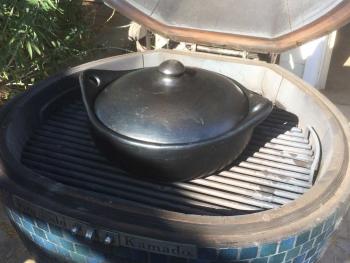
My latest toy arrived, a La Chamba Paella Pan, 12" from My Toque. I have actual carbon steel paella pans from The Spanish Table, which I will continue to use for classic Spanish paella using Bomba rice. This will be primarily for rice dishes broadly construed. Turkish? Indian? Hopefully I will figure out how to use Massa brown rice, the rice that turned me around that brown rice could actually taste much better than white rice. This would also make a nice Moroccan tagine. The classic tagine shape (which La Chamba makes) is a nod to a fire handling style that none of us practice; it has become pure theatre that I'm skipping. I'm also eyeing this as a nice cassoulet pot. I now have five La Chamba pots from various sources, and my friends have more. They have been made for eternity in the same Colombian village from black micacious clay, which lends strength. I've read accounts of potters in the U.S. southwest who have trouble breaking their mistake pieces made from micacious clay. The pots feel like incredibly dense wood, are basically non-porous, and I don't worry about or heat or flame. I'll turn a burner on high, or put a room-temperature pot into a hot oven or KK. I've never broken one, and I doubt it would be easy. The surface is smooth enough for sautéing at the start of a cook. They are so buffered that the more conventional shapes make great bean pots. I have lots of experience with other kinds of clay pots. Riado's Moroccan Souss tagine, also high mica, unglazed for cooking rather than show, and a steal at $29, is perhaps my favorite other piece. I'd love to buy everything in The Spanish Table's cazuela collection. Yet if I'd never heard of a clay pot other than La Chamba, I'd be very happy. My Toque does an impeccable job of packaging and shipping these pots, though I suspect they'd arrive fine on a dare, with just a UPS label glued to the bottom. As these are entirely handmade, I've seen variability in how lids fit. In my small sample size, the best specimens have come from My Toque. I suspect that their long relationship with La Chamba guarantees them the best pieces.
-
Aside from being better designed and built, the KK does handle differently from other ceramic cookers, as those of us who came from other cookers can attest. It acts like it is both better insulated (it is) and has greater thermal mass (perhaps also an artifact of the insulation). Landing a jet is different from landing an airplane, and sweating pipes with MAPP gas is different from sweating pipes with propane, even though each pair is logically the same. I found myself making adjustments when I switched to the KK. I use both CoCo Char (KK Extruded Coconut Shell Charcoal, for low and slow or critical cooks) and local hardwood briquettes (no off-tasting fillers) for everything else. Were I rich I'd just use CoCo Char, along with the occasional bincho or lump for effect. CoCo Char is so neutral and clean, one only worries about the heat soaking itself. CoCo Char is poor man's bincho. With any other charcoal, I find that fire handling dominates heat soaking in my thinking. The Achilles heel of all charcoal cookers is fire handling. In our dreams we have multiple hardwood fires, and we move beautifully mature embers from our seed fire to the cook fire. The occasional green wood makes an appearance to show off our advanced skills, but no flavors from the initial combustion of wood are accidentally introduced. The fire is deliberate, we are distilling the wood as an armagnac distiller is choosing the best part of the mash. Using a cast iron Dutch oven smoke pot, it is practical to control our smoking woods. It is harder to control our fuel charcoal. There are two kinds of charcoal fires: All coals burn together in an arc for a short cook, or the fire works its way through a day's supply for a low & slow. Many of us can identify a sooty taste from lesser charcoal as raw charcoal lights in the latter case, and that is why we exclusively use CoCo Char for these cooks. For any other charcoal, I want the fire to be everywhere, as one gets using a chimney in a Weber, before cooking. It helps to light everywhere with a weed burner torch. It helps to wait. Beyond this, there are still other motivations to wait. Grilled chicken is a prime example: As a guest, having Weber grilled chicken is an exercise in enduring the off tastes of burning chicken fat. Still, with better equipment, we associate that taste with grilled chicken. When manufactures first tried to move away from cans for tomatoes, consumers missed the taste of the can. The ideal paella socarrat crust is golden, not tending to black, but countless fond memories of beach paella make Spaniards rather tolerant of socarrat that is "further cooked". Some people who try smoke pots miss the off tastes of combusting smoke wood; were it simply a matter of flavor strength, they'd use a bigger smoke pot or take more care to get the pot going. When there is time, I like to cook chicken indirect on the tail of a too-hot fire, so the chicken cooks primarily from radiant heat from the KK walls, with no taste of burning fat. This is a choice, and the timing takes practice. A KK stays hot for a long time after the fire dies down; take advantage of this. We also like to use the tails of fires for other purposes, if we are staying up: A foil-covered Spanish cazuela is great for roasting potatoes and onions tossed in olive oil, salt, pepper, and pimenton. This is the ideal potato component for a tortilla (Spanish omelet), even if the original recipe instead deep-fries the potato. Or a half dozen sliced red bell peppers, tossed in salt and olive oil, cooked down till the liquid is nearly gone. With a hotter fire, give a carbon steel pan such as a paella pan another round of seasoning: heat it, rub in a very thin coat of lard, and let it blacken and cool at no higher than 600 F. With other ceramic cookers, a very long preheat can be critical for handling loads at the brink of capacity, such as 25-30 lbs of butt in a K5. With my friend's K5 I then heat the smoke pot in a gas grill, and add it while rebuilding the fire before adding the meat. This saves staying up for hours wondering if the cook will ever stabilize.
-
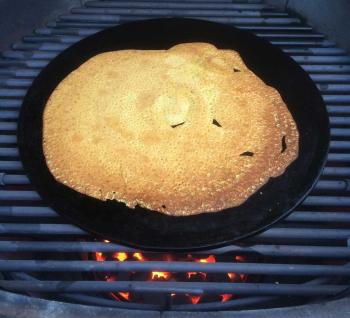
Socca (Farinata). Gotta love the Baking Steel.
-
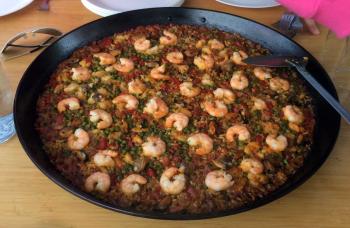
Another paella, with the neighbors. Carbon steel pan from The Spanish Table. They turn black once they're properly seasoned.
-
There's usually one or two of those in a 40# Lazzari hardwood lump bag. I'd save them for the right cook, leave them whole. Trouble was, there was also too many crumbs that would fall through a 1" screen. I switched to their briquets, exact same taste and easier handling. There's a kind of fire where one prefers lump, but not how I tend to use my KK.